
Physical AI: A Beginner's Guide to Jobs, Real Projects and Ground Reality
September 20, 2026
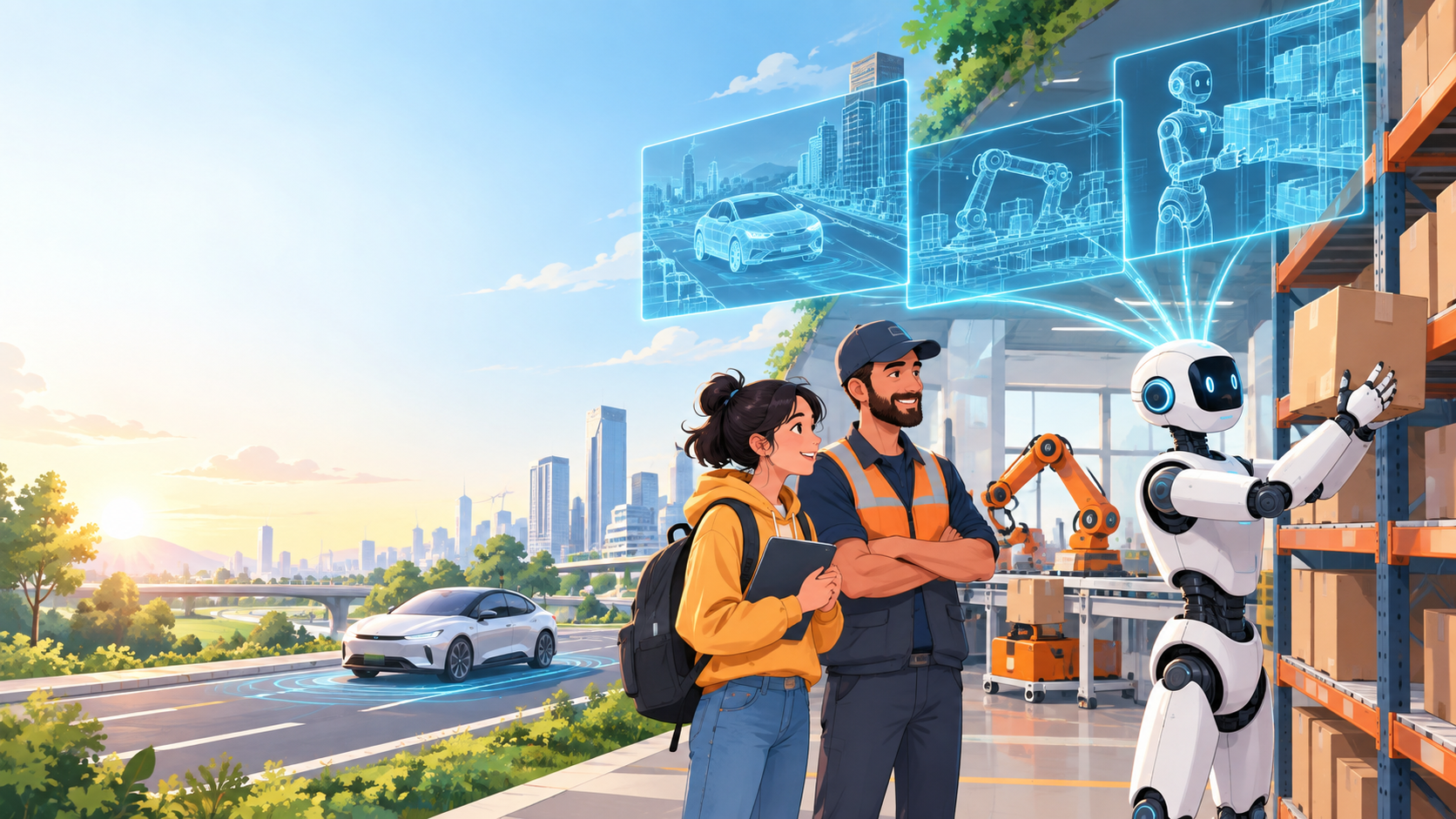
Physical AI is artificial intelligence that does not just answer questions on a screen. It sees, decides and moves in the real world, inside robots, self-driving cars and smart factories. If you are a student or a working professional wondering whether this field is worth your time, this guide gives you the plain-language basics, the jobs, the projects already running today, and an honest look at what still doesn't work.
Any word that might be new is explained the first time it appears. Let's begin.
What is physical AI?
Physical AI is AI that lets machines perceive, understand and act in the real world, usually from inside a robot or a self-driving vehicle. Think of it as giving AI a body and a set of senses.
Chatbots like ChatGPT learn mostly from text and images from the internet, so they know a lot about language but little about how the physical world behaves. Physical AI adds an understanding of space, weight, friction and cause-and-effect. That is why you will also see it called generative physical AI, and why searches for its meaning or definition all lead to the same idea: AI that closes the loop between seeing something and doing something about it.
Older robots were different. Before modern AI, robots followed fixed scripts and worked only in carefully arranged spaces. A physical AI robot can adapt when a box is slightly out of place.
Most systems combine three parts:
- Sensors: cameras, lidar (a laser scanner that measures distance) and touch sensors that act as eyes and skin.
- Models: the "brain." Many use vision-language-action (VLA) models, which take in what the robot sees, an instruction in words, and output movements. NVIDIA describes VLAs as the decision layer for self-driving vehicles and robots.
- Simulation: a virtual world where robots practise safely. Self-driving systems, for example, are trained in simulated environments so they learn to spot pedestrians and handle bad weather before touching a real road.
How is physical AI different from embodied AI and agentic AI?
Physical AI and embodied AI overlap heavily, and people often use them interchangeably. Some writers do treat them as separate ideas: embodied AI is the research idea that intelligence grows through having a body, while physical AI is the practical goal of machines that do useful work in the real world.
Agentic AI is different again. An agent is software that plans and takes steps on its own, like booking a meeting or fixing code, but it stays inside computers. Physical AI agents do the same kind of planning, then carry it out with motors and wheels. If agentic AI is a smart assistant at a desk, physical AI is that assistant walking onto the warehouse floor.
Which physical AI projects are running in production today?
Physical AI is already working at scale in three places: roads, warehouses and early-stage factories. "Production" simply means real customers and real work, not a lab demo.
| ProjectWhat it doesStatus | ||
| Waymo robotaxis | Driverless taxi rides | About 500,000 paid rides a week across 10 US cities (March 2026) |
| Amazon warehouse robots | Move inventory; coordinated by an AI model called DeepFleet | Over 1 million robots in 300+ facilities |
| Agility Robotics Digit | Humanoid moving storage boxes (totes) | Over 100,000 totes moved at a GXO warehouse |
| Figure AI at BMW | Humanoid handling sheet-metal parts | Pilot, not yet a revenue contract |
| Boston Dynamics Atlas | Humanoid for factories | Production began in 2026; committed to Hyundai and Google DeepMind |
A quick tour of the table. Waymo has grown from 50,000 weekly rides in May 2024, and it aims for one million a week by the end of 2026. Amazon says DeepFleet works like a traffic controller and cuts robot travel time by about 10%. A humanoid is simply a robot shaped roughly like a person, with two arms and two legs. Digit works alongside people in a live warehouse, handling the "last meter" jobs that wheeled robots and fixed arms struggle with.
What are other physical AI use cases?
Beyond cars and warehouses, physical AI shows up wherever machines must handle unpredictable objects or spaces. NVIDIA lists robot arms that adjust their grip to each object on a conveyor belt, surgical robots learning to thread needles and stitch, and warehouse robots that steer around people using their own sensors.
The pattern is simple: if a task is repetitive, physical and slightly different every time, it is a candidate for physical AI.
What jobs exist in physical AI?
Physical AI jobs range from building the robot's brain to running, training and repairing the machines, so you do not need a PhD to enter. Here are the main paths.
Robotics AI engineer. Builds the models that let robots see and act. A university posting for a robotics AI research engineer asks for hardware design, VLA integration and real-world testing. Good starting skills: Python, machine learning basics, and some electronics.
Simulation engineer. Builds the virtual worlds where robots practise, using physics simulators such as MuJoCo or Gazebo (free tools that mimic gravity and collisions). The same NUS posting lists these simulators as a core skill.
Robot data and training roles. Robots learn from examples, so someone must produce them. This physical AI data work includes teleoperation operators, robot trainers, annotation specialists, safety operators and field technicians. Teleoperation means steering a robot remotely so it records how a task is done. These roles suit career-switchers and people with hands-on backgrounds.
Solutions and applications engineer. Helps customers make robots work in their own workplace. One robotics data company hires such engineers to design data capture setups and talk to customers' robotics teams, a good fit for industry workers who already understand a specific sector.
Robotics technician. Maintains, repairs and installs robotic systems in industrial settings. Amazon reports that at its Shreveport, Louisiana centre, robotics led to a 30% rise in reliability, maintenance and engineering roles.
[YOUR EXPERIENCE HERE — the skill will not invent this]
What is the ground reality of physical AI right now?
Physical AI is real but early: a few systems work at scale, while most deployments are small, narrow and still being tested. Knowing this will protect you from hype.
- Most humanoid work is pilots. A mid-2026 guide notes that most deployments are still small fleets, not full factory rollouts. One tracker estimates roughly 75 Digit robots in use worldwide, with a plausible range of 40 to 150. Treat all such counts as estimates, since companies rarely publish exact numbers.
- Very few earn steady revenue. An April 2026 roundup says Digit was the only humanoid doing paid, productive commercial work at that time.
- Homes are much harder than factories. Homes are messy and unpredictable, which is why home robots trail industrial ones.
- Even the leader faces scrutiny. Waymo's numbers are large, yet regulators are investigating how its robotaxis behave around school buses, and Uber's human-driven business is still far bigger.
The honest summary: the technology is proven in narrow jobs, and the hard part now is reliability, safety, cost and scale. That is exactly where new talent is needed.
How can I start learning physical AI?
The fastest start is a hands-on physical AI course that lets you train a real or simulated robot. NVIDIA's free Physical AI learning path includes an intermediate tutorial of about 6 to 10 hours using a low-cost robot arm, and a longer 20-plus hour curriculum covering teleoperation, simulation and deployment on a small onboard computer.
A simple plan:
- Learn the basics: Python, basic machine learning, and how sensors and motors work.
- Practise in simulation: it is free and you cannot break anything. Try the tools named in the NVIDIA path, such as Isaac Lab and Hugging Face's LeRobot.
- Build something small: even a simulated arm picking up blocks counts as a portfolio project.
- Join a physical AI hackathon: these weekend build events are a fast way to meet teammates and get feedback.
- Bring your existing skills: electricians, mechanics, logistics staff and software testers are all valuable here, because robots must be installed, checked and supervised by people who know the real environment.
Is physical AI worth learning?
Yes, if you value learning that is grounded in reality. The field is young, the demand for people who can bridge software and hardware is visible in job listings, and the honest gaps (safety, reliability, cost) are real problems waiting for real people. You do not need to master everything at once. Pick one layer, whether models, simulation, data or maintenance, and take the first small project this month.